



Infection Prevention in Cardiac Surgery
Despite increasing infection control practices and advanced preventative steps, post-operative Surgical Site Infections (SSIs) have a huge impact across all surgeries and remain a significant cause of morbidity, prolonged hospitalisation and death.¹
Cardiac surgical procedures carry a particular high risk of post-operative infection, with infection incidence rates ranging from a reported 3.5% to 26.8% in cardiac surgery patients. Cardiac surgery surgical site infections (SSIs) are primarily categorised into superficial sternal wound infections (SSWI) and deep sternal wound infections (DSWI).²
Deep sternal wound infection is a serious post-operative complication that can occur following cardiac surgery. Reported incidence varies ranging from 0.3% to 8.0%.³⁻⁴ A meta-analysis found patients with DSWI after cardiac surgical procedures had increased risk of death as well as short- and long-term adverse clinical outcomes.⁵ Evidence suggests that the type of dressing used following surgery may impact the rate of post-operative infection.⁶
Beyond clinical outcomes, the economic implications are considerable: UK data suggests that SSIs lead to a median increased hospital stay of 10 days, with an associated median additional cost of £5,239 per episode, and NICE has identified that an SSI can increase the overall cost of surgery by two to five times.⁷
In cardiac surgery specifically, deep incisional and organ/space SSIs significantly prolong hospital stay, and the cost associated to this additional length of stay represents more than one-third of total hospital costs for affected patients.⁸
Wound complications are one of the major sources of morbidity and can prolong the inpatient stay or lead to re-admission. Recognising the potential for Surgical Site Infection (SSI) and complications may be the most important issue to address when discharging a post-surgical patient.⁹
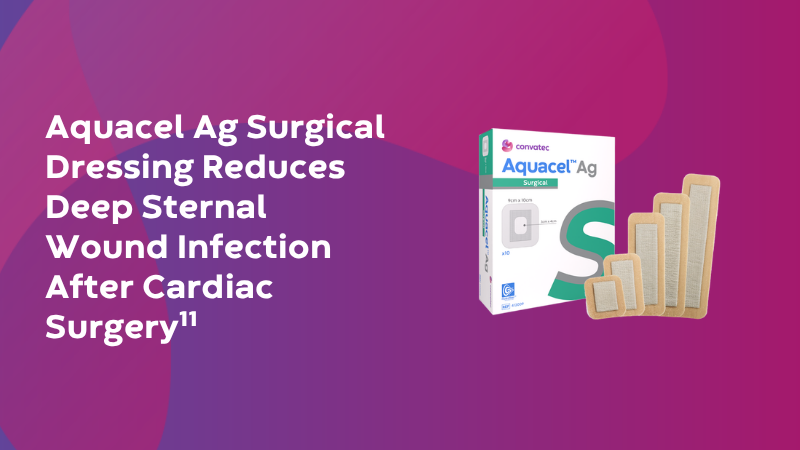
Aquacel™ Surgical Ag dressings offer a combination dressing with a mix of skin-friendly hydrocolloid technology for comfort during body movement, and Hydrofiber® Technology with ionic silver. The cover layer of polyurethane film provides a viral, waterproof and bacterial barrier*.
By combining exudate management, wound protection and antimicrobial action, Aquacel® Surgical Ag can support post-operative wound care strategies aimed SSI prevention, while maintaining patient comfort.
Silver containing Aquacel™ dressings have been tested against 61 different species and 185 different strains of micro-organisms, according to 25 peer reviewed publications, 1 poster and 3 pieces of data on file.¹⁰
A study in compared two groups of adult cardiac surgery patients following a change in post-operative wound‑care practice. 504 patients received standard dry dressings changed daily, while 208 patients received Aquacel™ Ag Surgical dressings worn for 5–7 days. Infection rates within 30 days were reviewed and demographic and clinical data were compared between the two groups to confirm they were similar and therefore suitable for comparison.
Deep sternal wound infection occurred in 17 patients (3.4%) with dry dressings and in none of the Aquacel™ Ag group (P = 0.012). Superficial infections were also lower with Aquacel™ Ag (4 vs. 15), though this difference was not statistically significant.
Using Aquacel™ Ag Surgical dressings significantly reduced deep sternal wound infections after cardiac surgery and may help lower related patient morbidity and healthcare costs.
Your post-op dressing selection can be the difference between healthy healing and an infected surgical site.
When Hydrofiber® Technology is in action, a layer of fibrin builds up between the dressing and the wound, but fibrin absorption by the dressing is minimal. Therefore, tissue ingrowth does not occur, resulting in pain free removal and greater patient satisfaction.
Hydrofiber® Technology is proven to demonstrate limiting levels of inflammation, which improves the healing process, resulting in good scar quality.¹² Along with this, the Hydrofiber® technology in Aquacel™ Ag Surgical Dressings has the fluid handling capability equivalent to 4 layers of Aquacel™ dressing.¹³
The ionic silver kills broad spectrum pathogens within 30 minutes. You can have the confidence this is occuring whilst your patient is in recovery.¹⁴
This study aimed to determine whether using silver-impregnated AQUACEL® Ag Surgical dressings after cardiac surgery could reduce the incidence of deep and superficial sternal wound infections compared with dry sterile dressings.
 ;
;
Aquacel™ Ag Surgical™ is the only post-operative dressing in the UK market combining Hydrofiber™ Technology and Ionic Silver. Pioneered by surgeons for surgeons.
 ;
;
*When intact and with no leakage.
1. Centers for Disease Control and Prevention (CDC). Surgical Site Infection (SSI) Event: Procedure-associated Module [Internet]. CDC; 2020. Available from: www.cdc.gov/nhsn/pdfs/ pscmanual/9pscssicurrent.pdf.
2. Zukowska A, Zukowski M. Surgical Site Infection in Cardiac Surgery. J Clin Med. 2022 Nov 26;11(23):6991. doi: 10.3390/jcm11236991. PMID: 36498567; PMCID: PMC9738257.
3. Schimmer C, Reents W, Berneder S. Prevention of Sternal Dehiscence and Infection in High-Risk Patients: A Prospective Randomized Multicenter Trial. The Annals of Thoracic Surgery, 86, 1897-1904
4. Lo Torto F, Turriziani G, Donato C, et al. Deep sternal wound infection following cardiac surgery: A comparison of the monolateral with the bilateral pectoralis major flaps. Int Wound J. 2020; 17: 683–691. https://doi.org/10.1111/iwj.13324
5. Perezgrovas-Olaria, R., Audisio, K., Cancelli, G., Rahouma, M., Ibrahim, M., Soletti, G.J., et al. (2023) Deep Sternal Wound Infection and Mortality in Cardiac Surgery: A Meta-Analysis. The Annals of Thoracic Surgery, 115, 272-280. https://doi.org/10.1016/j.athoracsur.2022.04.054
6. Cai J, Karam JA, Parvizi J, et al. AQUACEL® Surgical Dressing Reduces the Rate of Acute PJI Following Total Joint Arthroplasty: A Case-Control Study. J Arthroplasty (2014), http://dx.doi.org/10.1016/j.arth.2013.11.012
7. Jenks PJ, Laurent M, McQuarry S, Watkins R. Clinical and economic burden of surgical site infection (SSI) and predicted financial consequences of elimination of SSI from an English hospital. J Hosp Infect. 2014;86(1):24–33. doi: 10.1016/j.jhin.2013.09.012.
8. Scherrer C, et al. Economic burden of surgical site infections in patients undergoing cardiac surgery. Eur J Cardiothorac Surg. 2019;55(3):494–501. doi: 10.1093/ejcts/ezy303.
9. Surgical site infections: prevention and treatment NICE guideline Published: 11 April 2019 Last updated: 19 August 2020
10. Convatec data on file (RPT-076322 AWC-2024) approval SC-68982-gbl-eng-V1
11. Schubach, S., Montecalvo, J., Cosgrove, L., Heydemann, B. & Xu, M.L., 2014. AQUACEL® Ag Surgical reduces incidence of deep sternal woundinfection post-cardiac surgery poster. Winthrop-University Hospital, Department of Thoracic and Cardiovascular Surgery.
12. Krishnan R, MacNeil SD, MalvankarMehta MS. Comparing sutures versus staples for skin closure after orthopaedic surgery: systematic review and meta-analysis. BMJ Open 2016;6:e009257. doi:10.1136/bmjopen-2015009257
13. WHRI6551 MS171 ‐ In vitro performance characteristics of AQUACEL® Ag+ SCD and SCD SP
14. More, P.R.; Pandit, S.; Filippis, A.D.; Franci, G.; Mijakovic, I.; Galdiero, M. Silver Nanoparticles: Bactericidal and Mechanistic Approach against Drug Resistant Pathogens. Microorganisms 2023, 11, 369. https://doi.org/10.3390/ microorganisms11020369